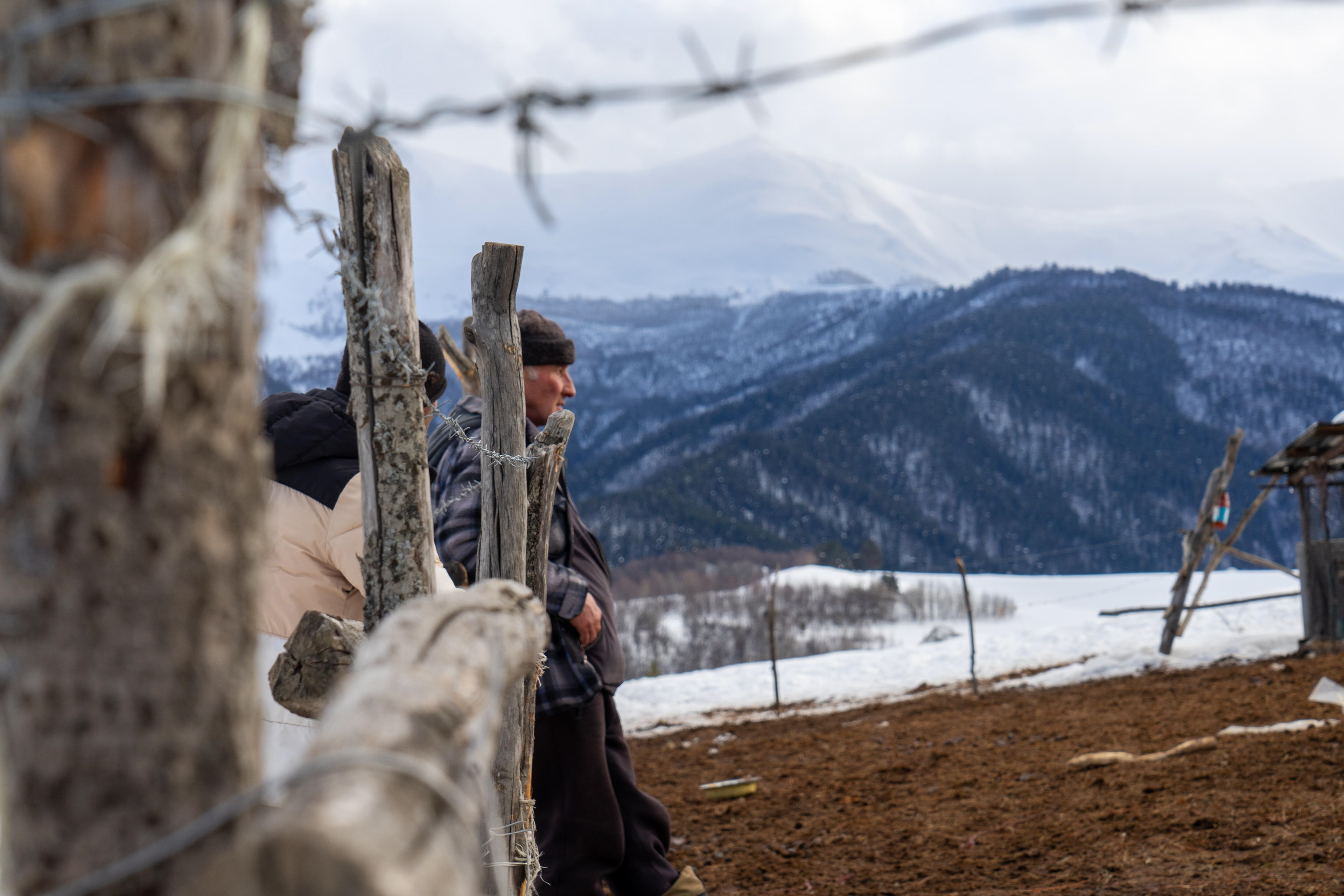
Two weeks in the Caucasus mountains.
In winter, the mountain closes off Tusheti.
The road linking the valley to the rest of Georgia is closed for several months. The mountain folds in on itself, buried under snow. No more driving up. The only access is by military helicopter, weather permitting. The valley is a strategic area, near the Russian border. The rotations serve resupply and military patrols, meant to happen every two weeks—but winter always decides the schedule.
We were supposed to leave earlier, but bad weather delayed the flight.
We arrived in Tusheti six days later than planned.
We arrived in Tusheti six days later than planned.
In winter, there are only eight of them living up there.
There is no store. Nothing to buy. Money has no function. It doesn't circulate, doesn't structure anything, doesn't guarantee anything. Here, you can't obtain anything through transactions. You depend on autumn reserves, canned goods, wood cut in time, livestock, and others.
The economy is one of presence and mutual aid.
Nothing is truly "one's own." Houses remain open. You can enter, sit down, wait. You will be welcomed. They will offer you tea, bread, chacha... They will share what there is. There is no abundance, but there is no refusal.
This is not naive utopia. It is a necessity.
Survival imposes mutual aid. Without apparent hierarchy, without a leader, the community functions through a tacit balance. An almost anarchic organization, yet deeply coherent. Everyone knows what they must do. Everyone knows they cannot live alone.
We arrived with all the food needed for two weeks. In the house: a stove. No electricity. Toilets outside, in the snow. No shower. Water, when it doesn't freeze, must be carried.
The night is total.
The silence, too.
You must learn to slow down. To accept discomfort. To understand that comfort is a modern construct, not a condition of life. Those who stay year-round do not do so out of romanticism. They do it because it is their world. Because this harshness also contains a form of freedom.
In this isolation, we see that another form of economy is possible.
It does not rely on money or private property, but on trust and the circulation of goods.
It can only exist because everyone depends on others, and the bonds between inhabitants are strong.
It does not rely on money or private property, but on trust and the circulation of goods.
It can only exist because everyone depends on others, and the bonds between inhabitants are strong.
Winter in Tusheti does not offer an exportable model. It simply reveals another way of inhabiting the world.
When the helicopter descends back into the valley, you carry with you this question: what could we retain from this way of living?